
Dispatch: Writing our way forward
Innovation requires collaboration; let’s start by sharing our thoughts in continuous conversation.

Innovating Communities is about being human in the digital age, carried by the places we live and work. I invite your participation through thoughtful comments, sharing with others, or supporting the work as a subscriber or patron. I offer talks, panels, AMAs, and keynotes to help bring ideas into practice.
Furthering a movement
This dispatch relaunches my newsletter as a travelogue—an account of my journey in search of community innovations. I’ll share observations gathered from conversations, articles and books, podcasts, videos and films, and lectures. Anything that might light our way forward. And occasionally, I will offer essay editions, as I’ve written for years: tightly worded arguments for methods, solutions, and outcomes that we might pursue, together, to build thriving communities.
Frequent readers know that I see communities, the places where we live and work, as an essential institution for the digital age—keeping us human and making us more so, even as the exponential impact of generative artificial intelligence takes root and explodes, everywhere.
The truth is, community innovations are already happening all around us, if we notice. Here are three sightings, taken from my travels over the last several weeks, while I was publishing look back editions:
The daughter of a generations-old ranching family opens a grocery to offer local products, join forces with other main street innovators, and grow prosperity in her town, dealing with unhelpful food-safety rules, adjusting, and searching for ideas that work.
A partnership of founders adds infrastructure and real assets to a coming venture fund, including physical coworking spaces intentionally designed for conversations and trust-building, aiming to create a public good in a private place.
A couple acquires land and builds a life in a place filled with ancient indigenous dwellings, modern-day native art, livestock for food and fabric, hard work and hospitality, and a community-shared water resource in a parched, sparsely populated terrain.
These sightings are meaningful steps forward, offered here without elaboration or explanation. But they are signposts, at most, pointing a way. I will return to each in future editions—some on their own for deeper study, others woven into larger tales of innovation.
That said, you deserve to know where I am going and what I seek to accomplish. Put simply, I hope to further a movement: not one that I’m building, but one already underway in many locales, evolving as nature does, unheralded and complex, according to what is needed in a place, making use of what is there.
I have catalogued at least 30 initiatives—some of them global, all of them seeking to build local community capabilities, prosperity, and resilience. Beyond what’s contained in the three sightings above, I would call out local agriculture, distributed manufacturing, craft beer and artisanal coffee, breadmaking businesses run from home basements, buy-local sourcing policies, walkable neighborhoods, and community investment funds, among many others.
Collectively, these initiatives are threads of localness. But they are not a movement—not really, not yet. Every initiative, every drive for localness that I encounter, achieves only a fraction of its potential because it fails to go mainstream and remains a niche and not the majority’s way of working, not an essential ingredient of our lives.
That’s where I can join in. I can beat a drum, amplifying ideas and stories. I can write about the many community innovations I find and put them forward as part of a whole—all pulling together, all striving, building, creating, and advancing, always advancing.
I can bring community innovations into contact with digital technologies, flagging founders and investors who are remaking our world, taking us where they will.
I see a symbiotic relationship. Localness will fall short of what might be achieved if it is not powered, in some way, by data and artificial intelligence. But digital scientists and technologists will not build the best possible future for humans if we, the people, do not give them something to aim for.
Such a target might be many things, but from where I sit, helping communities connect us with what makes us human and building a culture, economy, and society where communities matter, is a great place to start.
And when I can, I will pair innovators with others who can offer knowledge and resources—adding a measure of momentum and making our world just a little more human, a little bit better.
I’m talking about a shared vision for humanity. To lean in, I need a vision of my own: for my writing, for where it will take me, and how it will benefit us.
Seeking that same vision, I asked Anthropic’s Claude (oh, such a human name!) to suggest writers that might inspire my work: authors with a strongly humanistic bent, defenders of human language, the most accomplished artists of narrative storytelling. I was offered many alternatives and guided by my better angels to one: Toni Morrison, author of Beloved, speaking in her Nobel Prize acceptance talk. Reading and listening to her, more than a few times, I distilled this: The highest achievement of language is the reach toward the ineffable—that which is too great, intense, or sacred, perhaps even divine, to be put into words.
And there it is. An impossible striving, what we humans do best. The ideas and stories I share will be of science, art, and technology, but also of greater stuff: a belief that human life is guided more by gut instinct than deterministic design, and my faith in a future that is evolving, DNA-encoded—yet emerging, powered by wonder.
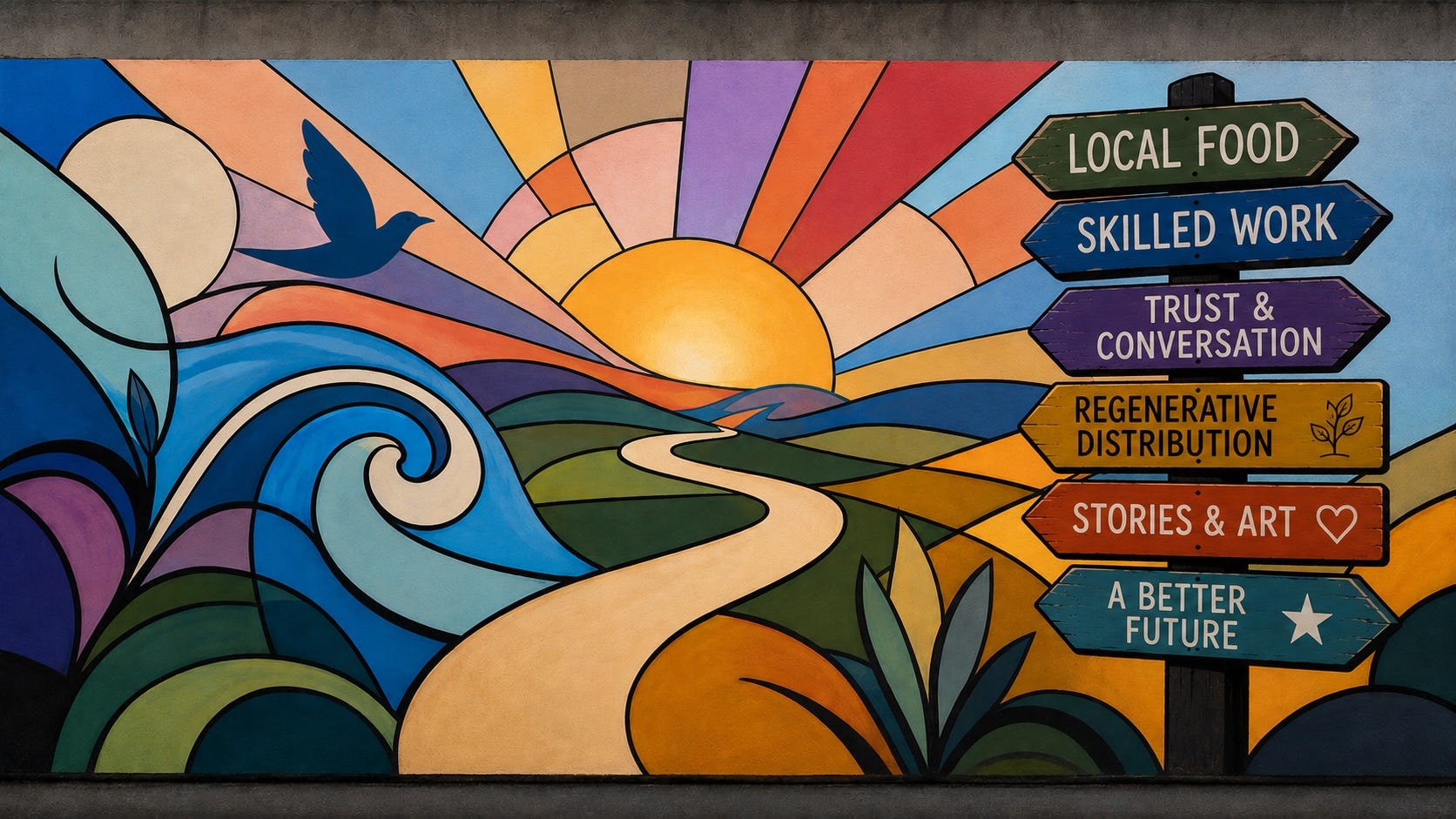
In that spirit, my dispatch editions can offer encounters that spark observations, moments that illuminate possibilities, and thoughts on where to look next. But I cannot, and should not, offer pronouncements or defenses, or even proofs. I might inspire. I must avoid lecturing. With luck, I will uncover headings and signposts, encouraging a shared journey, not plotting a determined path.
These are high words, meaningful to me and hopefully to you. The journey will tell. Here’s how.
Writing is often described as a solo art, but I don’t think of it that way. For me, writing is sending my thoughts to you, received when you read them, and completing a full cycle if you add them to yours. My mind to yours and back again. (If you think this is too woo-woo, read Michael Pollan’s new book, A World Appears, for an amazing journey into the new science—hard science—of consciousness.)
If you’d prefer a more traditional way to connect our minds, leave your comments below, or reach out directly at mark.dancer@n4bi.com. Let me know if we should talk live, on a call, or over a coffee.
Together, let’s build thriving communities, one innovation at a time.
Mark ... you might remember me ... we spoke in the context of your work with NAW ... the Irish guy! Life has moved on, as it does ... I sold the businesses and am now spending 50% of my time working (in an advisory capacity) with people I want to work with; 25% of my time tarvelling; 25% of my time arsing around (a slightly crude Irish term, in Italian it is close to 'dolce far niente'). I am also writing - there will be a book in 2027, but now there is a Substack. I thought you might be tempted to take a risk with 4 minutes of your time and read one of the pieces - they are all 3-400 words, the subject is life after the rails (after life on the rails) - substack is free and will always be free: aftertherails.substack.com . If it catches your attention, you might subsribe, you might comment, you might share a post or two, you might restack. Paul