
Making skilled work generative
Let’s respond to the digital revolution with a return to community-scaled innovation that is rooted in skilled labor, aided by technology, and dedicated to human flourishing.

Innovating Communities is a reader-supported newsletter. I invite you to leave a comment, share this article with others, consider a paid subscription, or support my efforts more directly. I offer talks, panels, AMAs, keynotes, and subscriptions. Please let me know how I can help.
It is the best of times; it is the worst of times. We stand at the precipice of fantastic and wondrous possibilities, and tech leaders are investing trillions to make them so. The future is bright for all things digital. But for humans, it is cloudy. Maybe stormy. It is hard to know whether what’s coming will serve us, create shared prosperity, or improve our well-being. We worry that the corporate survival instinct—grow or die, scale or disappear—will push AI’s platforms to consume what humans do: our work, our art, our thoughts, our lives.
But what are we to do?
For starters, let’s agree we are not in a Terminator apocalypse, battling diabolical and genocidal machines. The tech titans—OpenAI, Anthropic, Apple, Google, Microsoft, Meta, X, among others—are not our enemy. They are not overlords, nor are they our government.
In a democracy, the people are sovereign. We can stand our ground in the places we live—our cities, towns, and neighborhoods. Communities are the foundation of society, the places where we learn to vote and to lead, to care and to work, to be creative and to be resilient. They are where we launch our lives, become entrepreneurs and owners, forgive mistakes, and make life better.
Choose action, not passivity, and everything changes. Instead of merely reacting, we innovate. We strengthen what makes us human, beginning with work. Skilled work. Not algorithmic. Work done with our hands, our hearts, and our minds. Work that creates value we can touch, taste, hear, smell, and see. Human work.
Here’s something big: Let’s make skilled work generative—a source of renewal and growth, a mission that begins with us and shapes our future.
Generative work is not a theory. History is full of moments when skilled human labor produced far more than its output—work that became a source of pride and a signature of place. I don’t have to look far from my home for one such story. It lives in a town named for what it is: Pueblo, Colorado.
When a steel mill rose in Pueblo to supply rails for a growing nation, immigrants from Italy came to work there. More precisely, they arrived from Sicily, as a fourth-generation son of Pueblo told me. They arrived with little more than their know-how, their gumption, and a cultural instinct for flourishing. Outside the mill, they built shops and gathering places, shaping a town that could stand on its own.
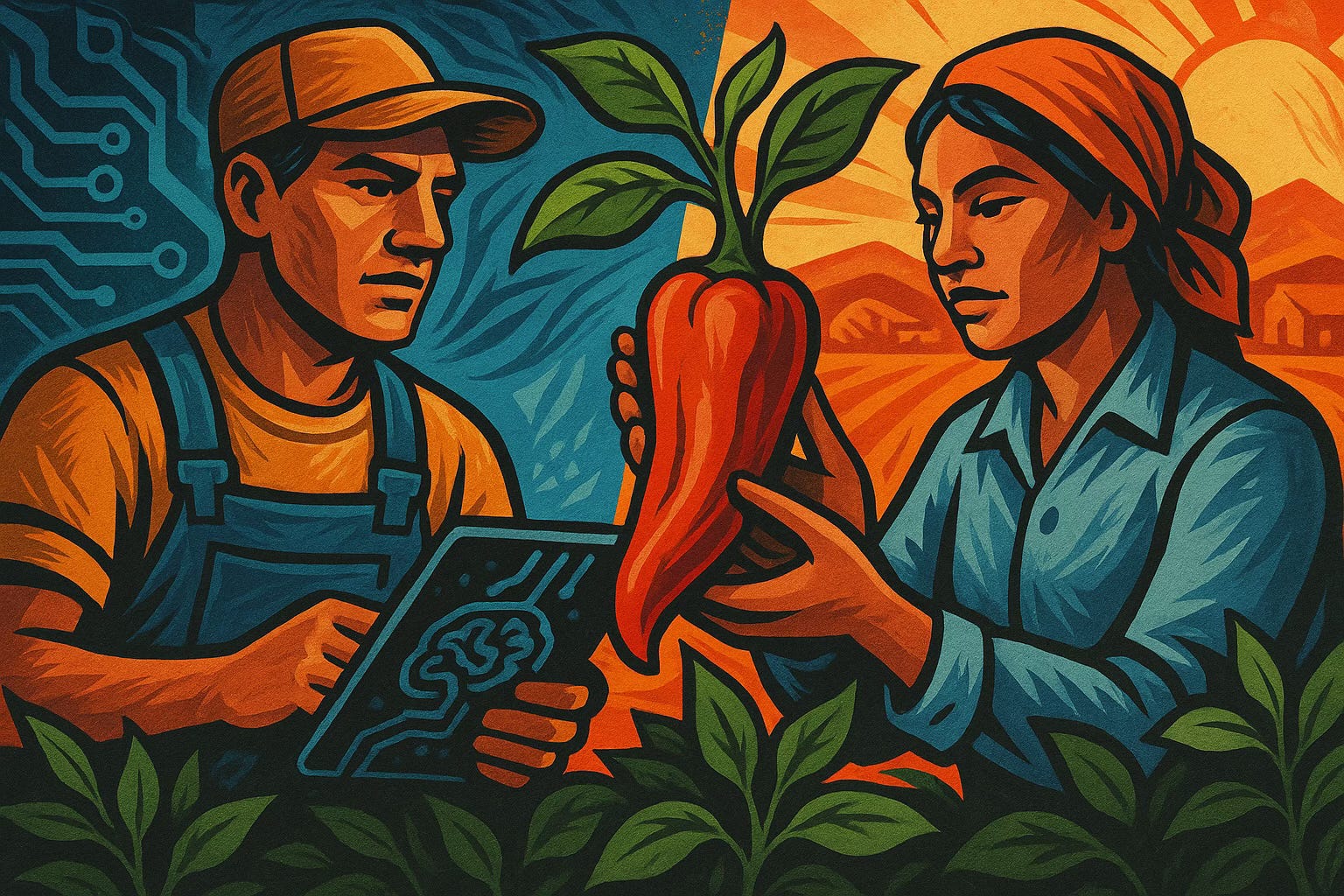
And to feed themselves, the mill workers gardened. Some gardens became farms. And, across generations, on those farms, they cultivated a pepper that thrived in the local microclimate. Over time, the Pueblo Chile industry emerged, producing a crop as iconic as its Hatch cousin in nearby New Mexico—a generative outcome born not from corporate strategy or economic incentives but from the labors of skilled workers.
The renewal of work is the rebirth of communities, of society, and perhaps, of humanity. But we need a plan—or, better, action. We must build a new civic infrastructure to tell the story of skilled work, foster connections, and enlist technology in our cause. We can spark modern-day Pueblos everywhere—shining lights for the digital age.
I suggest three community institutions, borrowing from tradition and updated for our time: a storytelling lab, a connection guild, and a technology works.
A storytelling lab gives skilled workers their voice, expressed through journalism and art, supported by training, mentorship, and collaboration with editors and artists. A lab works because it is a workshop—a place to make stories and expressions that can be published and exhibited. When workers learn to tell their stories—and help others do the same—society begins to see their contributions anew.
A connection guild restores one of humanity’s oldest institutions: people bound by shared craft, methods, standards, and respect. A guild is not a club or a network. It is a living fellowship. In a connection guild, skilled workers find one another across trades and generations, exchanging ideas and passing on wisdom. It also catalyzes interactions with community leaders, experts, startup founders, and teachers. Like any strategic base, a guild builds resilience through solidarity. It gives workers not only comradeship, but the collective energy generativity requires.
A technology works is the forge of the future. It is a “works” because it is a collaboration where industry is made, like the glassworks or shipworks of a generation ago. In a modern works, design, data, robotics, and applied AI come together to augment—never replace—skilled work. A technology works is where digital machines become tools in the service of the people who build our world.
Working together, a storytelling lab, a connection guild, and a technology works are more than policies and programs; they are more than feel-goodisms. They form a local platform for crafting a culture rooted in the places we live. A culture that learns—no, yearns—to fend for itself.
We stand at a hinge. AI without us? Or a partnership? The people and the titans. Making it work. To deepen this work, we need allies.
One example ally comes from Colorado State University’s Office of Engagement & Extension, which chronicled the Pueblo Chile story and showed how educators can empower individuals and strengthen a community’s work.
Another comes from the Palmer Land Conservancy and filmmaker Ben Knight, whose documentary MIRASOL: Looking at the Sun traces the pressures of generational transfer, residential development, water scarcity, and the fight to sustain a way of life.
A third comes from Pablos Holman’s Deep Future, a call to invest in bold, world-shaping technologies—not the digital toys of convenience, but the innovations that build a future worth living in.
And a fourth comes from TWIN Global’s gathering in St. Petersburg, home of Haddy, where Proximity became a technology north star and innovators gathered with entrepreneurs, artists, futurists, and civic leaders—much like a modern Chautauqua—to share ideas and chart what’s next.
Together, these examples point a way forward: skilled work renewed, place-based innovation unlocked, technology used wisely, and a restored sense of human agency. We can make our future.
Are you ready? Are we?
Please leave a comment, send a DM on Substack, or reach out directly at mark.dancer@n4bi.com.
Together, let’s build thriving communities, one innovation at a time.
Great insights Mark! I agree with what you’re saying and what I’m curious about is how these get guilds/shops/networks get started. I’ve seen some that just seem to grow out of thin air and others that fail despite the massive amount of time and money put into them. Thoughts?
I see those three institutions serving the community well. Seeing a community flourish is going to take a different approach than what we've been doing and I believe your vision is one that benefits the community!