
Vision 2026: A community-centered approach to leading change
Innovation will shape our future, driven by people and accelerated by technology–with human flourishing as the ultimate goal.

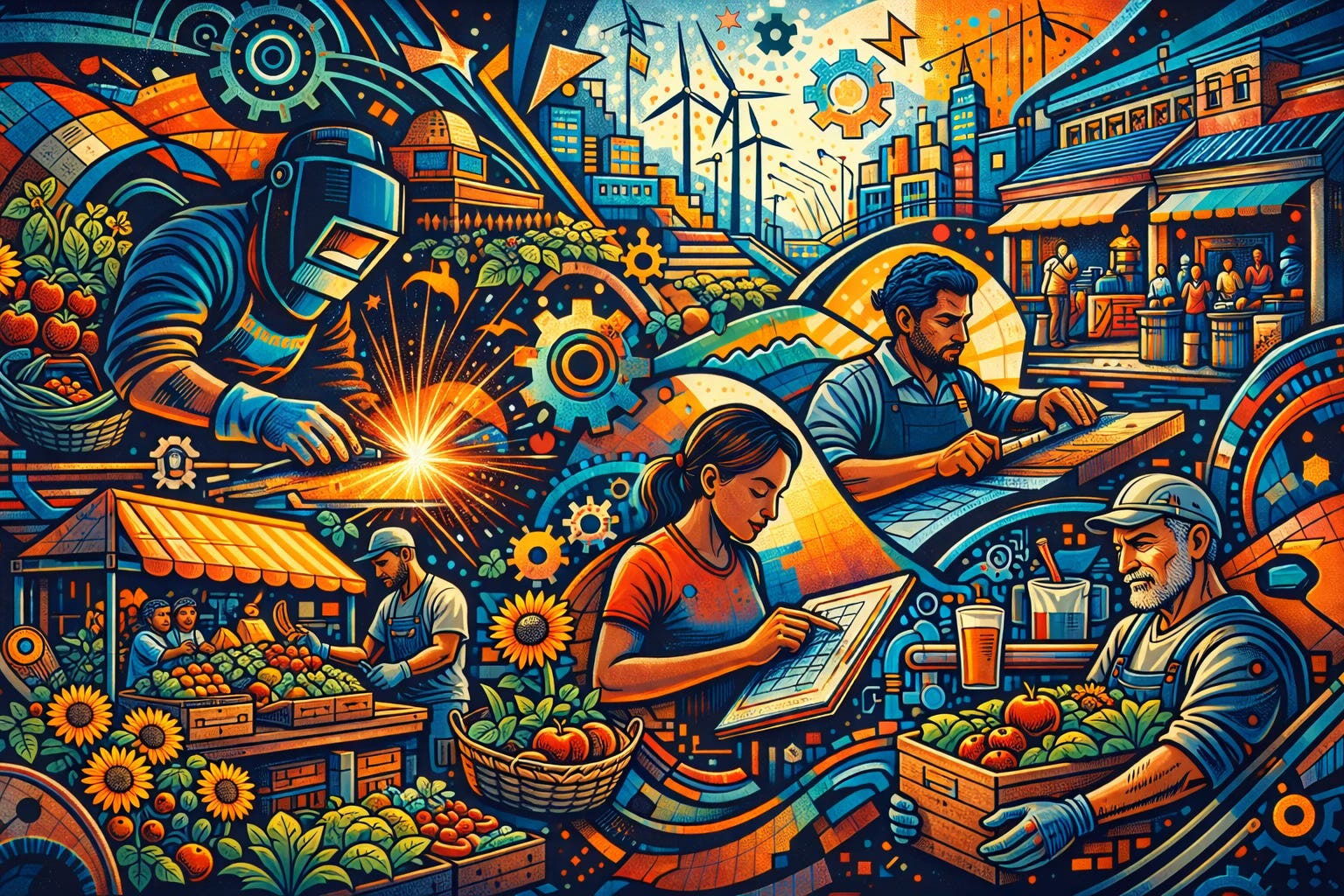
This edition shares my vision for Innovating Communities and my plans for 2026. It grows directly out of the conversations, questions, and thoughtful challenges many of you have shared with me, and I’m grateful for them. I’m entering the new year with renewed intention and energy. I want to tell stories, test ideas, and build collaborations. My work is not possible without your support, and I hope you’ll share it with others.
I see a radiant future, grounded in hope. A future that is more human, not less. A future built by a people who imagine what is possible and strive to make it real. At the center is a simple conviction: we must connect with what makes us human. We must not lose ourselves to technology, but use it to serve our lives, lives shared as a people, embracing innovation and care, and starting in the places we call home, our communities. From there, we can renew our humanity and craft a human-first world, a more perfect world, formed by its society, economy, and culture.
Let me explain. When communities work at their best, they hold us together, provision us, and help us endure.
There, society anchors us in norms, institutions, and governance through shared rules and responsibilities. The economy sustains work with returns, honoring the exchange of effort and value. Culture cultivates shared meaning, lived values, and belonging. Individuals matter, but we do not stand alone.
Community identity is uniquely inclusive. It does not erase difference, but it cuts across it, bringing people together across income, race, age, belief, and background, not by sameness, but by shared place and shared fate. Communities are imperfect, sometimes fragile, but when they work, they are powerful.
This is the world as it has worked, imperfect but resilient, for as long as people have come together to do what they could not do alone.
And then the world changes.
We live in a moment of exponential possibility. Digital technologies, especially transformative artificial intelligence (TAI)1, are powerful beyond anything we have ever known. They promise to energize our thinking, transform our work, and accelerate discovery in ways once the stuff of science fiction. Many of the builders inventing products and companies want to do the right thing. Increasingly, they speak convincingly about alignment, human benefit, and collaboration. What they say matters, and I take them seriously.
And yet, something is missing.
We are innovating faster than realizing where we might go as a people. We are not working to improve our civic commons, our mutual well-being. We talk endlessly about how AI will reshape industries, while saying far less about how it should strengthen the our life together. Instead, a commercial mindset dominates, with imagination carried in words like users and consumers, experiences and markets, agents and products. We aim for something superhuman, not more human. Replacing, not helping.
We have the right values, but we need better design.
What if we began with this: as AI moves through the world in ways subtle and seismic, whatever happens, we commit to becoming more human, not less, and measure success by lives better lived?
Getting there requires showing the way by designing, launching, and judging human-centered projects—experiments really—in the real world where we live and work. In these efforts, we can invite technology to join us—not to augment, automate, or replace us, but to work alongside us as we strive to build a world of human flourishing and well-being.
Toward a better world
Look around, and you can already see progress taking shape in places where local, human-scale design is made real. At Big Green, where growing food becomes a shared pursuit for families and farmers, teachers and founders. At Arizona Sake and Tostado Santiago, where food and drink are of the community, by the community, and for the community. And in Pueblo, Colorado, where blue-collar work is not just a legacy, but a future.
These are only a few of the projects I have come across and shared in more than 200 editions. I write about them because I see in them something worth naming: the emergence of a new discipline of innovation married with care, one grounded in local solutions forged in communities.
Starting at home, we can renew our society, economy, and culture. We can lead technology forward with purpose and shape a human-centered future for all of us, the persons (not personas!) who live here, in the real world.
But examples are not enough. If we want a more human future, we must distill what makes these projects work. Not as slogans, but as hypotheses we can test, practices we can teach, and designs we can repeat—community by community.
I keep coming back to the same question: how do local, community-centered inventors reconnect us with what makes us human? By restoring connection. With each other. With food and water. With energy and work. With the places we call home. With ourselves. And with something larger than ourselves. These connections are not decoration. They are the mechanism. They are how communities become healthier, more resilient, and more prosperous—one for all, and all for one.
We can do this. We can change the world. For the better. With technology. For humans.
But not without a way forward.
I take inspiration from the principle of Proximity, as defined by Robert Wolcott and Kaihan Krippendorff: technology reshapes the world by delivering products, services, and experiences ever closer to the time and place they are needed. In my work, that time and place is where people actually live—the cities, towns, and neighborhoods we call home. Communities.
Proximity completes the idea at the heart of this edition. It shows how digital tools, especially transformative artificial intelligence, can strengthen human-centered innovation by restoring communities as the forge of human flourishing. It helps the green shoots I have mentioned above as projects—innovations married with care—take root and spread. Proximity turns human connection into human works.
From 5 to 50
So, this is what I can do, my plan for the year ahead:
I will focus my work on surfacing ideas and exploring projects that exist at the margins and help move them toward the mainstream. Not by proclamation, but by practice. By turning insight into action and values into structure. I think of this as 5 to 50 work: taking efforts that show up in small pockets today and helping them reach a point where they can sustain themselves and spread.
To do that, I will work in four formats. First, I will journal as a creative act, using writing not just to record ideas, but to discover, test, and refine them. Second, I will publish dispatches, timely and conversational, to surface patterns, questions, and emerging people and projects that deserve attention. Third, I will create videos exploring what it means to be a local, community-centered business in the digital age.
And finally, I will continue writing essays, published every four to six weeks, meant to connect ideas across constituencies and invite broader participation. None of this works in isolation. Each format is a tool, and together they form a message, possibly a movement.
We do not need a smarter world so much as a more humanly connected one. We do not need superhuman intelligence so much as intelligent systems designed for how humans aspire to live. Innovation will shape the future. The question is whether it will boldly deepen our humanity or quietly erode it.
Thank you for reading my vision and plans, thinking alongside me, and caring about where we travel together. If this work resonates, I hope you will share it, challenge it, and join in the effort. We will build the future not through intelligence alone, but through how we choose to live.
Please leave a comment, send a DM on Substack, or reach out directly at mark.dancer@n4bi.com.
Together, let’s build thriving communities, one innovation at a time.
Transformative Artificial Intelligence (TAI) describes AI systems powerful enough to reshape how societies organize work, decision-making, and daily life, not incrementally, but at civilizational scale. The term is used throughout The Digitalist Papers, Volume II to distinguish these systems from earlier, task-specific forms of AI.
This article comes at the perfect time; honestly, balancing digital life with Pliates reminds me how challenging, yet essential, your human-first vision is.